


Guides Guides
Why EasyDraw Capillary Testing Is as Good as Venous Testing Under Proper Conditions

Written by SiPhox Health Research Team

Written by SiPhox Health Research Team
Last updated: October 7, 2026
6 mins read
Many people assume venous blood draws are automatically more accurate because they collect more blood. In reality, accuracy depends less on the size of the tube and more on whether the sample type has been properly validated, whether there is enough usable sample for each assay, and whether the sample is processed on validated laboratory equipment.
At SiPhox Health, we use the EasyDraw arm collector to collect capillary blood from the upper arm. EasyDraw was validated in an internal 470-subject comparative study in which capillary samples were collected at the same time as venous samples and the results were compared directly. SiPhox has also validated its 50+ supported biomarkers, including hormone, metabolic, chemistry, lipid, and related health markers, using this capillary collection workflow.
That means EasyDraw capillary testing is as good as venous testing under proper collection, handling, and processing conditions. A paired study of 480 adults comparing fingertip and upper-arm capillary collection against matched venous samples on a single integrated analyzer platform found capillary and venous results clinically comparable for 16 of 18 routine analytes once sample-quality cutoffs were applied. [1] Similar equivalence has been demonstrated for other upper-arm collection devices, with 17 of 19 analytes falling within CLIA acceptance limits against matched venous samples. [2]
At the same time, traditional venous collection often requires far more blood than the analyzer itself needs. Modern chemistry analyzers require under 50 µL of plasma for a routine comprehensive metabolic panel, and hospital laboratories have been shown to collect roughly 8.5 times the required analytical volume for a complete blood count and about 12 times the required volume for a basic metabolic panel, with much of the sample discarded. [3,4] Large reference labs may request multiple tubes because their workflows are built around high-throughput routing, tube-type requirements, volume checks, and separate lab stations. That does not mean every assay requires that much blood. It often means the lab is collecting enough blood to make processing easier across a large, divided system.
So the real comparison is not “small sample versus large sample.” The better comparison is validated EasyDraw capillary collection versus traditional venous collection. EasyDraw capillary testing delivers venous-level performance while using substantially less blood.
EasyDraw collection happens at home, but the testing itself happens in a laboratory setting.
SiPhox works with CLIA-certified and CAP-accredited laboratories, and samples are processed using professional laboratory analyzers. The same analyzer runs both venous and EasyDraw capillary samples, which means the assay volume requirements are the same once the sample is ready to be tested.
The analyzer needs the correct sample type, enough usable volume, and proper processing conditions. It does not need a large venous tube. What it actually requires is the per-assay volume plus the instrument’s dead volume, which varies by platform and container. [3,5]
EasyDraw isn’t assumed to match venous testing because it’s convenient. Each biomarker is evaluated against defined acceptance criteria, including coefficient of variability expectations, some of which differ by gender, such as CRP and C-peptide. Results outside the expected two-deviation acceptance window are not considered viable.
That marker-level validation is what supports the conclusion, for the biomarkers SiPhox supports, when samples are collected and processed properly.
Traditional venous collection is designed for large-scale lab operations. It is not always designed around the minimum blood volume required by the analyzer.
For example, a large reference lab may ask for several vacutainers for a panel that, in a more optimized workflow, uses a much smaller amount of blood. This is because reference labs often collect extra blood to support operational efficiency. Conventional large-volume collection tubes have been shown to collect blood far in excess of analyzer requirements, and low-volume alternatives can match analytical performance at a fraction of the draw. [6]
There are several reasons for this:
This does not mean the extra blood makes the test more accurate. It means the lab’s workflow is designed to make processing easier and more reliable at scale.
A venous blood draw can require multiple tubes even when the actual analytical volume used by the instruments is much smaller.
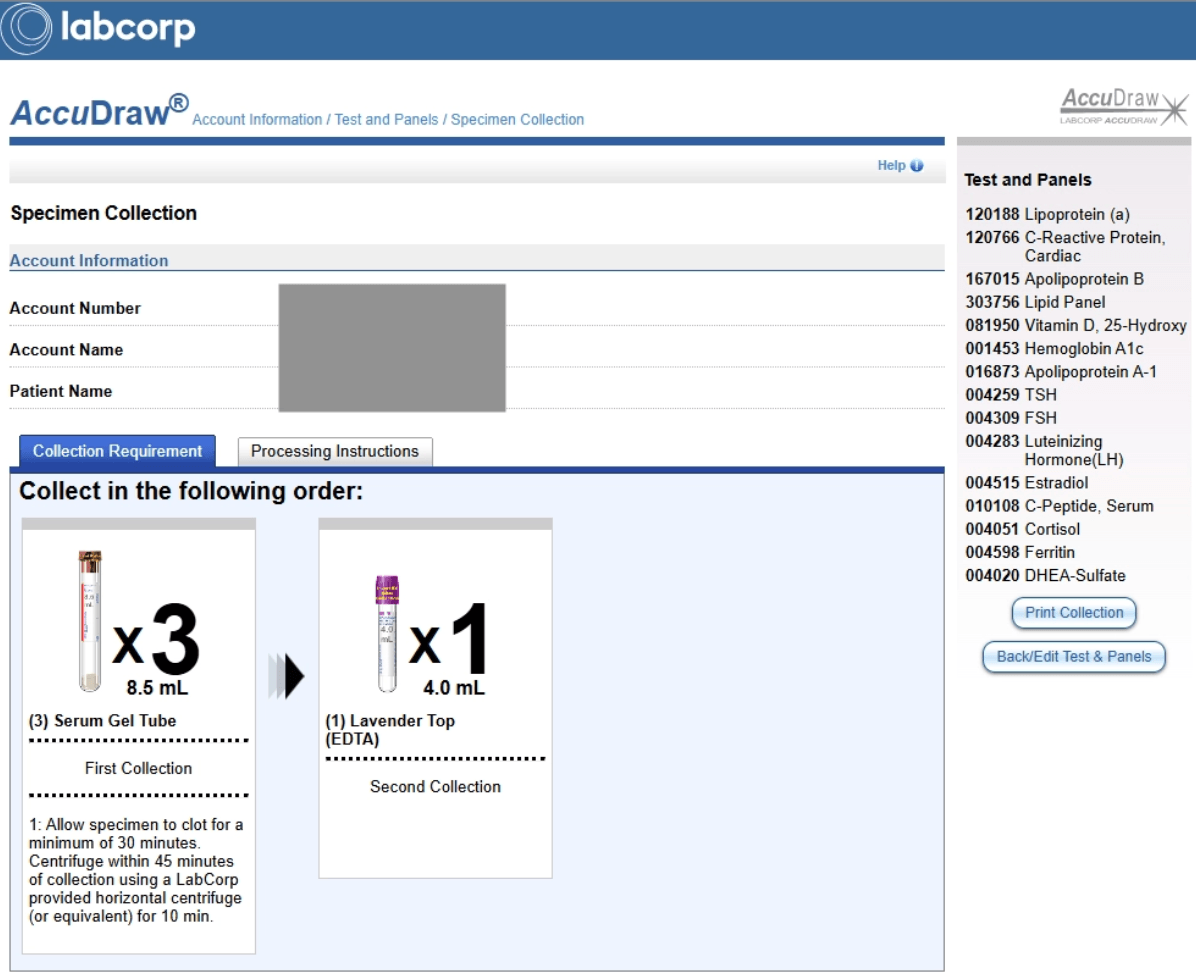
The Labcorp AccuDraw example above shows a panel requiring three serum gel tubes and one lavender-top EDTA tube. The listed panel is the SiPhox longevity panel that includes markers such as Lipoprotein(a), C-reactive protein, Apolipoprotein B, a lipid panel, vitamin D, HbA1c, Apolipoprotein A-1, TSH, FSH, LH, estradiol, C-peptide, cortisol, ferritin, and DHEA-S.
The collection requirement is three serum gel tubes at 8.5 mL each plus one lavender-top EDTA tube at 4.0 mL.
SiPhox runs the same panel from one microtainer: about 0.5 mL. Instead of giving each lab station its own full tube, the sample is aliquoted and routed based on what the panel actually needs. SiPhox also designs its panels around validated markers, which avoids specialty tests that carry their own tube or handling requirements.
Under proper conditions, EasyDraw capillary testing delivers venous-level results while requiring substantially less blood.
Those conditions matter: the collection method must be validated, the biomarkers must be validated, the sample must be collected and handled correctly and processed on appropriate laboratory equipment, and there must be enough usable volume for each assay.
Traditional venous collection uses more blood not because every test analytically requires it, but because large reference labs are built around routing, separate stations, volume checks, and specialized tube requirements.